
Sex Offender Checks in Bamberg County
The official starting point for Bamberg County is the free South Carolina SLED/SORT search. It covers public registry entries maintained through SLED and county sheriffs. Choose a geographic search to look around an address, city, ZIP code, or Bamberg County as a whole. A name search is better when the person is already known. Both routes sit behind conditions of use and a verification step.
The Bamberg County Sheriff's Office is the local registration contact, but the research found no separate county list or map. That distinction matters. SORT is the public search layer, while the sheriff handles local reporting and verification duties. Searchers should note spelling, aliases, location, and the date or status shown. A reported address may change before a new verification reaches the public system, so a profile should be read with SLED's update warning in mind.
Bamberg County Registry Conditions
Bamberg County users must accept SORT's conditions before the search tools appear. The gate is part of the registry's lawful-use framework, not a subscription or payment wall. SLED also recommends a current version of Edge or Chrome and warns that Firefox or Safari may behave in an unpredictable way. If a search page will not load or a control does not respond, a supported browser is the first practical fix.
The SLED registry entry page introduces those terms and the available public tools. The captured official page below helps identify the correct state source before entering any name or address.
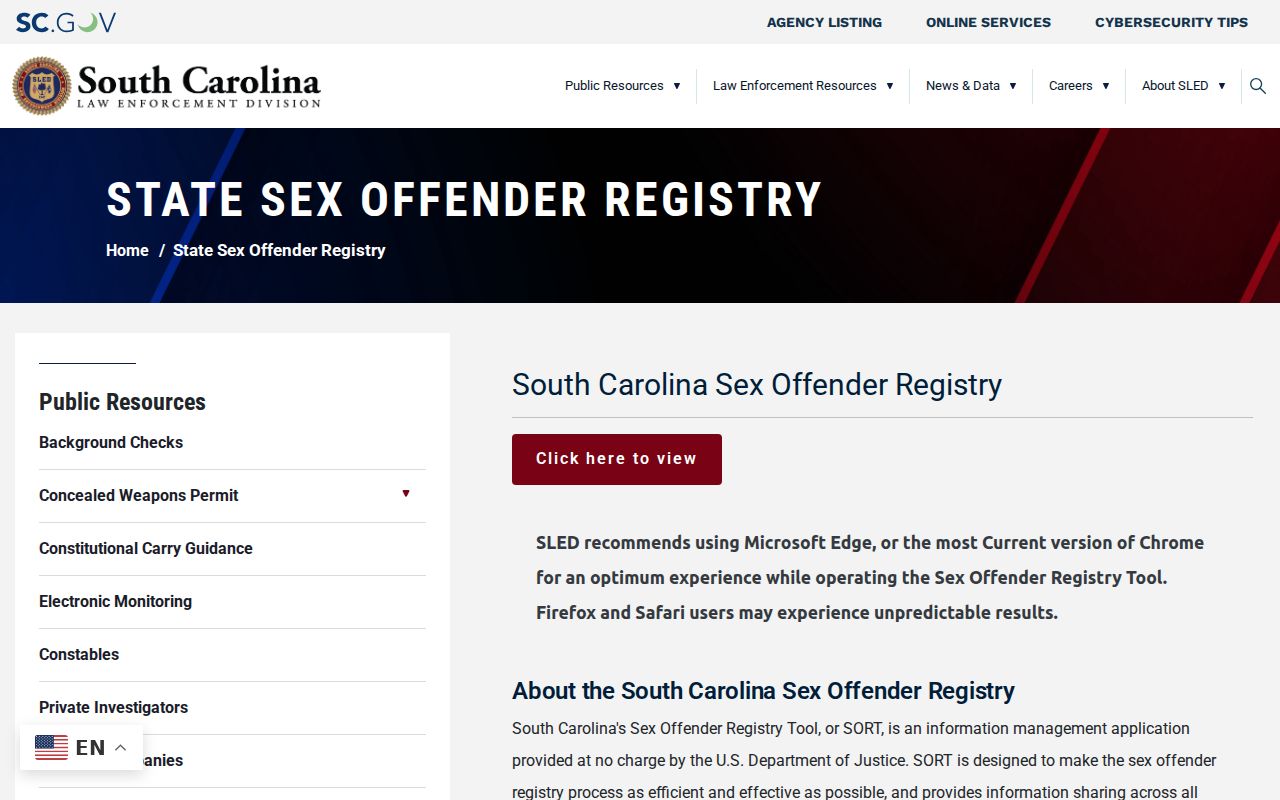
This state entry point separates the public registry from unrelated commercial search services and routes users toward SORT, removal forms, contacts, and registry resources.
How to Search the South Carolina Sex Offender Registry
A Bamberg County sex offender search can be broad or precise. Geographic tools help with community awareness around a place. Name fields help distinguish a known person. Use only enough detail to narrow the results, then inspect the complete profile rather than relying on a result card or map marker.
- Open SORT, read the conditions of use, select “I Agree,” and complete the verification code.
- Choose Geographic Search for a place-based check or Name Search for a known person.
- Enter an address, city, ZIP, Bamberg County, radius, or the available name fields, then submit the search.
- Open the matching profile and compare aliases, physical details, address, conviction data, photographs, and registration status.
| Search control | Type | Required | Use |
|---|---|---|---|
| Conditions of Use / I Agree | Acceptance | Yes | Opens the public tools after terms are accepted |
| Verification code | Text challenge | Yes | Must be completed before the interface |
| Address, City, ZIP | Text or selection | Conditional | Sets the geographic search point |
| County and Radius | Dropdowns | Conditional | Select Bamberg and the displayed distance option |
| First and Last Name | Text | Last name conditional | Searches for a known registrant |
| Community Notifications | Tab and form | No | Creates location-based notices after terms are accepted |
The official SORT interface shown below is the exact search destination listed in the manifest.
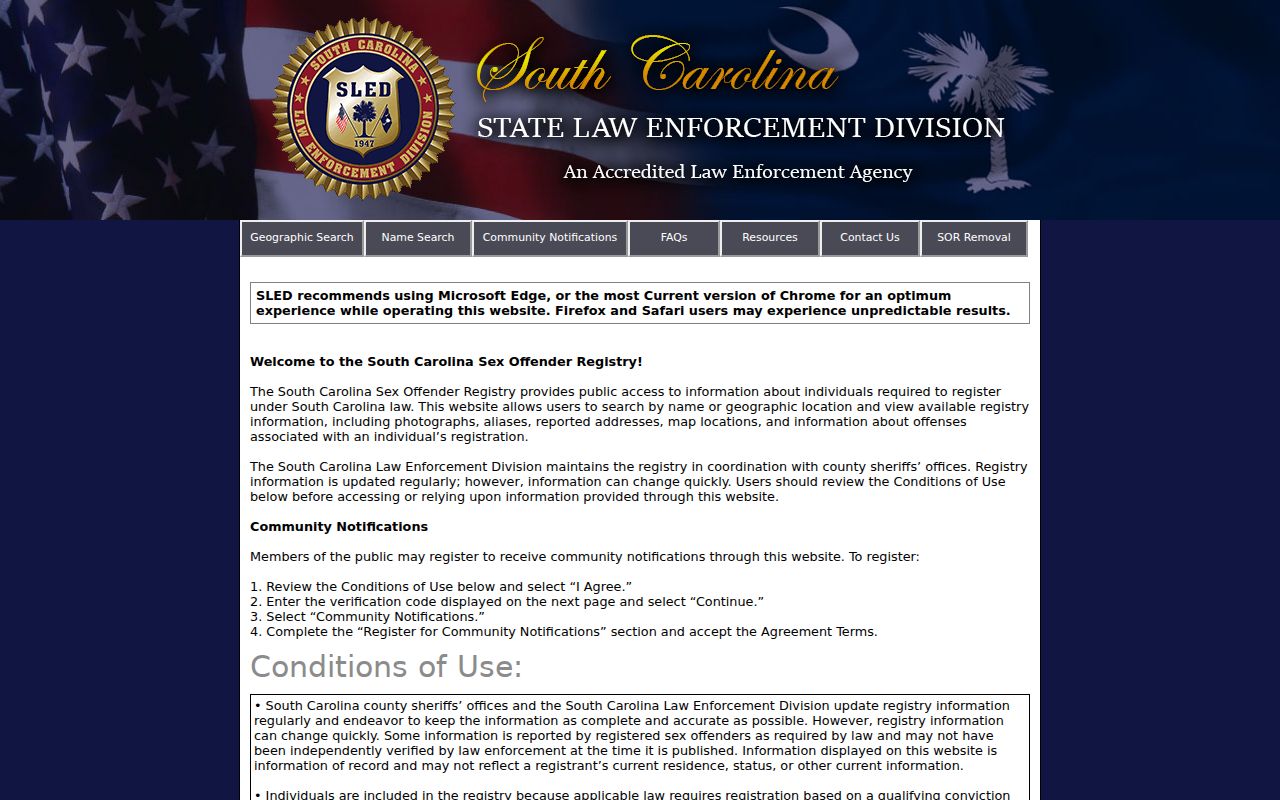
Its separate geographic, name, and notification paths let Bamberg County readers match the tool to a specific safety question without treating one search mode as a full investigation.
Bamberg County Registry Office
The Bamberg County Sheriff serves as the local registry contact. The office is at 509 North Street, Bamberg, South Carolina 29003, and the published registry phone is (803) 245-3018. Call before traveling. The official sources did not publish the appointment process, local verification schedule, registration entrance, or any local fee. Staff can confirm those current details and direct a registrant to the right part of the facility.
Bamberg County Sheriff
Registry contact
509 North Street
Bamberg, SC 29003
(803) 245-3018
SLED and county sheriffs update the public system together. That does not mean each posted address has been checked at the instant a visitor searches. For a correction to a public entry, contact the SLED Sex Offender Registry at (803) 896-2601 or sor@sled.sc.gov. The mailing address is PO Box 21398, Columbia, SC 29210.
The local office and state unit serve different needs. Call the sheriff about a Bamberg County reporting appointment, local entrance, or verification procedure. Contact SLED when a public profile contains an apparent error, when a state form is needed, or when the question concerns the public registry itself. Keeping those roles separate can prevent a correction request from being sent to an office that does not control the disputed field.
Inside a Registry Profile
A public Bamberg County registry profile combines identity, location, conviction, and registration fields. SLED says profiles may include several photographs taken over time, a visual residence map, aliases, and all sexually related convictions. The law also permits publication of identifying characteristics, date of birth, home address, registering offense, conviction place and date, Internet identifiers, and a current photograph.
| Name and Aliases | Legal name and other names linked to the registry entry |
|---|---|
| Photos and Description | Current or prior photos plus physical traits, marks, or tattoos when listed |
| Registered Address | Reported residence and a visual map; it may not reflect a real-time field check |
| Offense Details | Registering offense, statute, conviction date, city, and state |
| Vehicles and Identifiers | Vehicle or Internet identifier data when the public entry includes it |
| Registration Status | Compliance, registration, verification, and address-history information as available |
A listing means the person meets a registration rule tied to a conviction. It is not a warning that the person will commit another offense. SLED expressly cautions that registrant-supplied facts may not yet be verified and can change quickly.
Bamberg County SORT Versus NSOPW
SORT is the detailed South Carolina layer. The U.S. Department of Justice National Sex Offender Public Website adds searches across participating state, territorial, and tribal registries. SLED says SORT sends automatic updates to NSOPW, yet the national tool remains a supplement. When a person may have lived outside South Carolina, checking both can reveal which jurisdiction holds the controlling profile.
The manifest's official NSOPW capture appears below and shows the cross-state search source used for Bamberg County registry research.
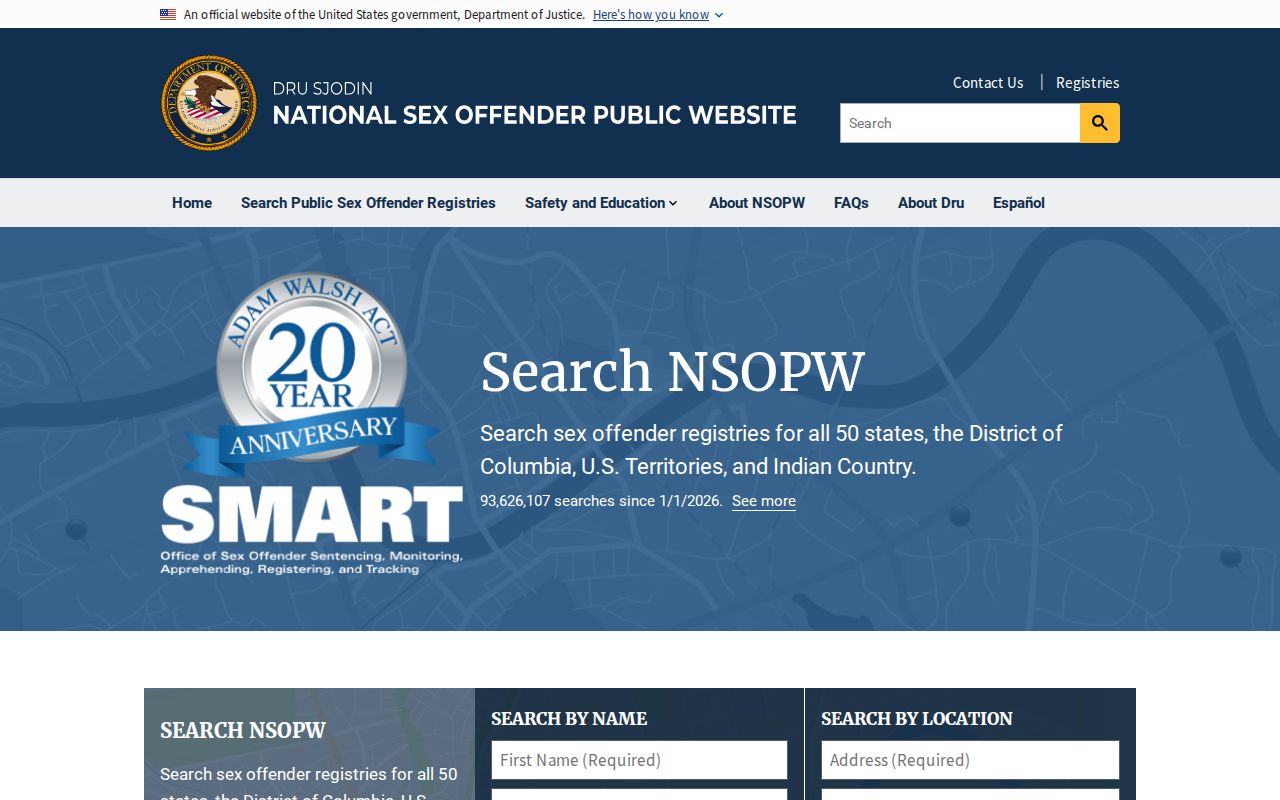
A result should still be opened at the contributing jurisdiction's registry. That source holds the local profile fields, reporting status, correction channel, and jurisdiction-specific terms needed to interpret the match.
Note: A no-result search is not a guarantee that no registrable record exists, especially when a name, location, or source system has changed.
South Carolina Registration Levels and Requirements
South Carolina uses Tier I, Tier II, and Tier III classifications for removal timing. The research does not provide one universal public verification frequency for each tier, so no schedule should be inferred. Registrants must keep reporting until SLED or a court grants written relief. The 2022 and 2025 legal framework created removal paths that differ by tier and procedural route.
| Tier | Earliest removal measure | Channel |
|---|---|---|
| Tier I | After 15 years registered, discharge without supervision, or end of active supervision | Paper administrative application to SLED |
| Tier II | After 25 years on the corresponding measure | Paper administrative application to SLED |
| Tier III | After 30 years from discharge without supervision or end of active supervision | Motion in General Sessions under §23-3-463 |
Out-of-state and federal convictions are assigned an equivalent federal SORNA tier and may qualify when the convicting jurisdiction permits removal. Timing alone does not grant relief. The record, supervision status, treatment proof, and correct legal channel all matter.
Bamberg County Registry Removal
An administrative removal request goes to the SLED SOR Unit, not the Bamberg County public search screen. The packet requires the paper application, two recent FD-258 fingerprint sets, a $250 nonrefundable cashier's check or money order, sentencing and disposition documents for each registering conviction, and official proof that required treatment was completed. Applicants must keep registering while the request is pending.
SLED notifies the original prosecutor and, once the application is verified, acts within 120 days. A denied applicant must wait five years before filing again. Tier III relief uses a General Sessions motion instead of the same administrative route. The exact conviction and equivalent tier determine which process applies, so a search result alone is not enough to decide eligibility.
Bamberg County Registry Notifications
Community Notifications sit inside SORT. Accept the conditions, pass verification, open the notification tab, and enter the requested contact and address information. Agreement terms apply before enrollment. This option is useful for ongoing awareness because it does not depend on repeating the same geographic search by hand.
Alerts do not turn a reported address into a live location feed. They reflect changes passed through the registry system. Families should use the information as one part of a practical safety plan, verify the source entry, and avoid drawing conclusions about people who share or live near a listed address. For a questionable profile field, use the SLED correction contact rather than confronting anyone.
Choose an address that matches the area of concern and keep the enrollment details current. A notification is most useful when the contact route still works. If the alert points to a Bamberg County profile, open that state entry and read its status and dates instead of relying only on the alert message. The registry remains the source record for the public details.
Community Notification and Lawful Use
The registry exists for public awareness and safety planning. South Carolina law makes selected registration information available for public inspection and online dissemination under Title 23, Chapter 3. That access carries firm limits. A profile must not be used to harass, injure, threaten, or commit a crime against a registrant, a household member, or anyone at the reported address.
Registry misuse can increase punishment: Under S.C. Code §23-3-510, registry information used to commit a misdemeanor can add up to $1,000 and six months, while a felony term may rise by five years.
Read entries as official public records with stated limits, not as invitations to contact or monitor individuals. If immediate harm is suspected, contact law enforcement through an appropriate emergency or nonemergency channel. Questions about Bamberg County registration procedure belong with the sheriff, while profile corrections and removal administration belong with SLED.